Fabricated Criminal Records and Case Files
Three SecondsFabricated Criminal Records and Case Files give Piet Hoffmann the official past he needs to enter Aspsås Prison as a credible and dangerous criminal. Assembled and altered by Erik Wilson, the documents convert a covert operation into a story that can be verified against police, court, and prison records. They are more than a cover sheet: the false history must survive questions from other prisoners, fit the prison system’s administrative procedures, and make Hoffmann’s assumed identity believable enough to protect the operation.
Construction of a Criminal Past
Wilson’s method begins with access to the Swedish National Police Board’s records for Hoffmann. At the National Court Administration, he recruits a civil servant to change the first page of the file. The existing sentence for firearms offenses, recorded as one year and six months at Österåker Penitentiary, is changed to five years. Wilson then asks for attempted murder and aggravated assault on an officer to be added. These changes are designed to create a longer, more intimidating record: in prison, a five-year sentence for serious violence would signal that Hoffmann was someone capable of force and likely to be taken seriously.
The alterations are made after hours, in a nearly empty office. The employee changes the sentence on the screen, prints the revised criminal record, and hands it to Wilson. She trusts that he is acting in the interests of society and crime prevention; the arrangement also gives her a sense of importance and human contact. The narrative makes clear that this trust is being used. Wilson knows she is risking prosecution for gross document forgery, while he relies on her access to make the false record look like an official one.
The resulting papers identify Hoffmann by the record number 721018-0010. They are meant to bridge the gap between his real history and the identity he must perform. Wilson has not simply added an alarming conviction: he is preparing a record that other people may inspect, compare, and use to judge whether Hoffmann belongs in the criminal world he claims to inhabit.
Supporting the File with an Investigation
Wilson expands the cover with a new section from the police criminal records and an interrogation transcript inserted into the documentation of a preliminary investigation that had taken place ten years earlier. The transcript attributes to Hoffmann the use of a Radom 9mm pistol and a firearms assault on Constable Dahl in Söderhamn. In the invented account, witnesses from nearby flats support the allegation. Hoffmann’s response in the staged exchange is that he has never been to Söderhamn; the contradiction is part of the constructed case, not evidence of an actual crime.
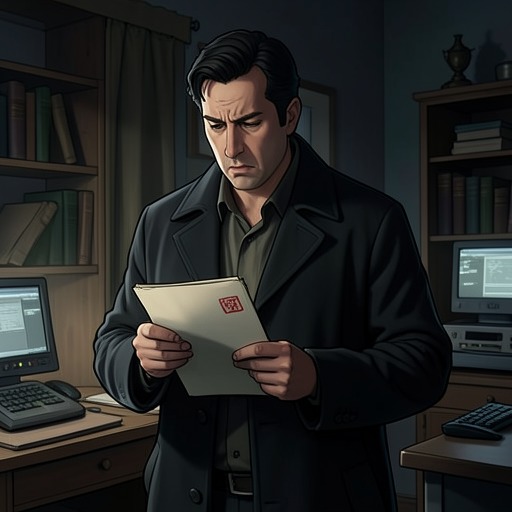
Wilson says he has worked on each component so that the combined background will be credible and sustainable. The interrogation material is designed to give the criminal-record entry a supporting narrative, while an added note says Hoffmann was kept in handcuffs during questioning for security reasons. That detail helps make the fabricated file read as a coherent record of a dangerous suspect rather than as a bare list of convictions. Hoffmann folds the two pieces of paper together after reviewing them, carrying the administrative fiction into the prison setting where it will be tested.
The papers are not self-sufficient simply because they look official. The book explains that a change to a criminal judgment would ordinarily require a new hearing concerning the original investigation, as well as corresponding entries in the Prison and Probation Service files at the prison where the sentence was served. Wilson’s deception therefore has to work across related records and procedures. The false background is assembled as a system of mutually reinforcing details, even though its foundation is fabricated.
Use at Aspsås Prison
The file’s immediate purpose becomes clear when Hoffmann enters Aspsås Prison. Before his arrival, Stefan Lygas and Karol Tomasz Penderecki have helped circulate copies of his supposed criminal records, intelligence-database entries, prison records, and most recent judgment. Stefan’s lawyer provides access to these materials. The papers thus reach the prison community in advance, helping establish the identity Hoffmann is expected to inhabit before he can explain himself in person.
On his first day in the unit, Hoffmann chooses a place in the television corner from which he can see the returning prisoners and be seen by them. He deliberately acts as someone who is not afraid of taking up space: he sits in a favored chair, uses marked cards, and begins a game without asking permission. At supper, older prisoners demand to see his papers. Stefan and Karol Tomasz try to intervene, but Hoffmann lets the questioning proceed. The documents are the proof demanded by an informal prison order in which status must be demonstrated, not merely claimed.
The criminal history also supports the larger undercover plan. Hoffmann has entered the prison to gain standing and work with members of Wojtek; the records make him appear to have the experience and dangerous reputation that such a position requires. When Wilson explains the planned use of isolation as protection and eventual extraction, the cover remains a practical condition of survival, not just a disguise used at admission. Hoffmann’s assumed identity has to retain its credibility through changes of place and risk inside the prison.
Exposure and Institutional Significance
The false dossier cannot guarantee Hoffmann’s safety. At a later point, he realizes that one of the prisoners who had been part of his protection and escape plan has betrayed him. The prison’s informal networks can therefore turn the identity established by the records into a vulnerability: the same criminal persona that helps him gain standing also places him within relationships where exposure may bring danger. When a riot squad escorts him to the voluntary-isolation unit, the immediate response is a change of location and controlled contact, not a correction of the fabricated history.
The documents also belong to a wider pattern of official recordkeeping that Ewert Grens uncovers. Searching back one year, he finds 302 secret intelligence reports describing cases in which an informant’s work to uncover one crime had led to another crime being marginalized. He recognizes investigations that had failed despite relevant knowledge already being held inside the organization. In a confrontation with Lars Ågestam, Grens points out that Ågestam had prosecuted 23 cases without the information contained in the secret reports. These disclosures establish a distinction between the incomplete material available to ordinary investigations and the concealed account held in secret intelligence reporting.
The novel’s closing distinction between fact and fiction sharpens the significance of Hoffmann’s fabricated record. It states that police have used criminals as covert human intelligence sources while denying and concealing the cooperation, and that criminal-intelligence databases and reports have been used to create credible personal histories. In this setting, official documents do not simply preserve an identity: they can be manipulated to manufacture one, while concealed information can distort investigations carried out in the name of law. Hoffmann’s papers are a concrete instrument of undercover work, but their plausibility depends on a system in which records, access, and truth are already compromised.